Showing posts with label Children's book. Show all posts
Showing posts with label Children's book. Show all posts
Friday, March 6, 2020
Bears In The Night
To me, "I Can Read" is a death sentence for a good story. A child might be able to read it, but would she want to?
A story should be beautiful and satisfying, something to be enjoyed. The best stories are, of course, also the most educational; but I doubt whether anyone wrote a good story by setting out to be educational first.
So when my son produced an "I Can Read" title from the children's nook at our meat market, I inwardly groaned and pooh-poohed and rolled my sophisticated eyes. The Berenstains wrote it? Poor folks. I hope they didn't suffer much.
It was nothing but prepositional phrases.
And it was marvelous.
You know what you can do with prepositional phrases? You can tell the story of a bedful of bear cubs decide to go investigate a nighttime noise. With prepositions you can get them out of bed, to the window, down the tree, and around the landscape. Because there are a quantity of cubs, you can use the same prepositional phrases multiple times, craftily placed against the illustrations, to create a follow-the-leader scenario. And you can use them all yet again when the bear cubs hastily conclude bed is the best place to be after all.
And by combining your magical phrases with simple, exciting drawings you can fire a child's imagination, and maybe send him out the window and through the forest on a nighttime excursion of his own.

Tuesday, February 18, 2020
CrossCountry Cat
by Mary Calhoun; illustrated by Erick Ingraham
Initial impressions can be misleading, as both Henry the cat and I found out.
 At first this book struck me as a little chilly, because the text is terse and the illustrations are rather sparingly tinted. Also, snow is wet and deep, and cats can't ski.
Or can they?
It turns out the text is well-worded, poetic almost, with wonderful characterization of actions. The author clearly is a skier herself, and she captures the awkward beginning "step-step-teeter," the successful "glide and slide" of skis over snow, and the satisfaction of a "loose and breezy" descent. She's equally good with the affectionate attentions of a cat or the distinctive flight of a blue jay.
And the illustrations are actually as rich as the wording is spartan. They're drawn with careful detail (I could swear the ski boots on the first page are the exact pair my dad used to wear). At the same time they're capable of big sensations, like the vastness of a lonely winter landscape and the smothering closeness of a snow-laden woods.
The story is, of course, impossible. Cats can't ski. But people can, and those who do will enjoy sharing this book - and, one would hope, the experience - with the children in their lives, as I do with mine.
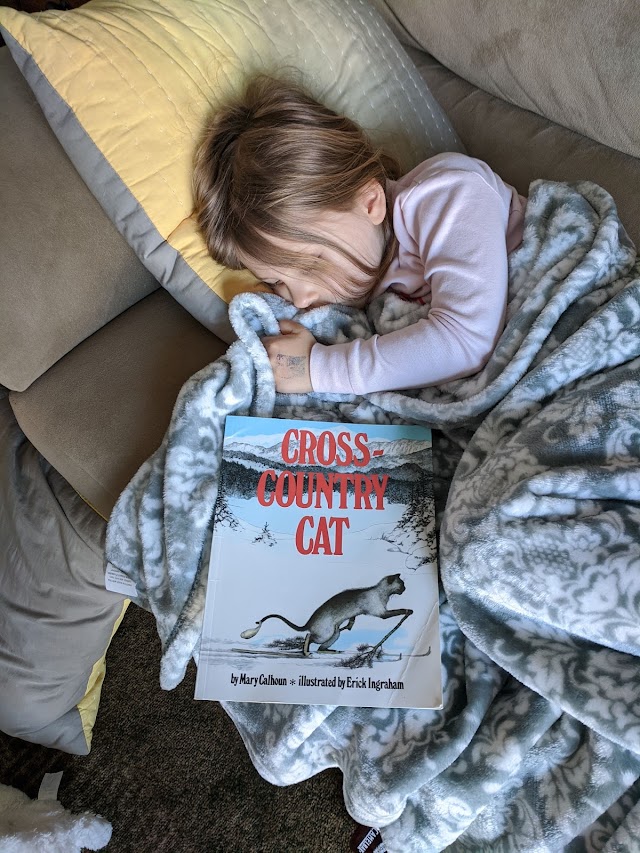
Initial impressions can be misleading, as both Henry the cat and I found out.
At first this book struck me as a little chilly, because the text is terse and the illustrations are rather sparingly tinted. Also, snow is wet and deep, and cats can't ski.Or can they?
It turns out the text is well-worded, poetic almost, with wonderful characterization of actions. The author clearly is a skier herself, and she captures the awkward beginning "step-step-teeter," the successful "glide and slide" of skis over snow, and the satisfaction of a "loose and breezy" descent. She's equally good with the affectionate attentions of a cat or the distinctive flight of a blue jay.
 |
The story is, of course, impossible. Cats can't ski. But people can, and those who do will enjoy sharing this book - and, one would hope, the experience - with the children in their lives, as I do with mine.
Thursday, February 6, 2020
Mustafa
written and illustrated by Marie-Louise Gay
"Mustafa and his family traveled a very, very long way to get to their new country."
We're not told where they came from, or where they settled; it's not important to this story. What is important is that Mustafa is an immigrant, and we have a chance to learn from him.
Gay's beautiful illustrations begin the story from the copyright page, cleverly showing the long, somber journey with which she opens her text. Fanciful details throughout the artwork suggest wonder and strangeness without compromising the essentially real story.
Composed in short, simple sentences, the narrative could seem stilted. Instead it is poetic, and effectively cryptic. Through it we experience Mustafa's fledging courage, his crippling shyness and increasing loneliness, and the security of his mother's love. Gay also gently evokes Mustafa's alienation from everywhere - from both the old country, familiar but grim, and from this new home with its disorienting abundance and a language he doesn't know. Perhaps this, more than anything, defines the immigrant experience.
The main thread of the story is the persistent, and ultimately triumphant, kindness of another child. She's certainly an example for us to follow, if we're ever fortunate enough.
But there's also an underlying theme, culminating midway through story, that makes Mustafa himself our example. Because he's not familiar with changing seasons, the brilliant autumn foliage strikes Mustafa as magical. Looking around, he spies a lady speaking with birds and concludes she must be the wonderful person responsible for such beauty. What we see is, of course, a destitute old woman feeding pigeons. We can smile at Mustafa's naivete; but perhaps he is actually wiser than we are.
Like Vladimir Nabokov's novel Pnin, this story for children moves us with compassion for the stranger, then moves us beyond compassion to respect and even awe.
"Mustafa and his family traveled a very, very long way to get to their new country."
We're not told where they came from, or where they settled; it's not important to this story. What is important is that Mustafa is an immigrant, and we have a chance to learn from him.
Gay's beautiful illustrations begin the story from the copyright page, cleverly showing the long, somber journey with which she opens her text. Fanciful details throughout the artwork suggest wonder and strangeness without compromising the essentially real story.
Composed in short, simple sentences, the narrative could seem stilted. Instead it is poetic, and effectively cryptic. Through it we experience Mustafa's fledging courage, his crippling shyness and increasing loneliness, and the security of his mother's love. Gay also gently evokes Mustafa's alienation from everywhere - from both the old country, familiar but grim, and from this new home with its disorienting abundance and a language he doesn't know. Perhaps this, more than anything, defines the immigrant experience.
The main thread of the story is the persistent, and ultimately triumphant, kindness of another child. She's certainly an example for us to follow, if we're ever fortunate enough.
But there's also an underlying theme, culminating midway through story, that makes Mustafa himself our example. Because he's not familiar with changing seasons, the brilliant autumn foliage strikes Mustafa as magical. Looking around, he spies a lady speaking with birds and concludes she must be the wonderful person responsible for such beauty. What we see is, of course, a destitute old woman feeding pigeons. We can smile at Mustafa's naivete; but perhaps he is actually wiser than we are.
Like Vladimir Nabokov's novel Pnin, this story for children moves us with compassion for the stranger, then moves us beyond compassion to respect and even awe.
Saturday, January 25, 2020
Boy + Bot
by Ame Dyckman; illustrated by Dan Yaccarino
Boy + Bot is a story of unlikely friendship. The concept is not new, but the effectiveness
of Ame Dyckman’s simple text makes her story a treat for children and adults
alike.
“A boy was collecting pine cones in his wagon when he met
a robot.”
Right away we learn that this is the sort of boy
who is happy loading up his wagon with pine cones, and he lives in the sort of
place where pine cones are abundant. It’s
also the sort of place where stray robots crop up (because, as it turns out, it’s
the sort of place where reclusive inventors live in castles somewhere up the winding
road). A story-world in fourteen words.
Quite matter-of-factly the boy and the robot become friends, and in two ensuing episodes one or the other of them is incapacitated (the robot
is accidentally powered off; the boy falls soundly asleep), prompting his
companion to attempt a rescue. These
parallel episodes are as poignant as they are amusing; each character is
distressed for his friend and tries earnestly to help, but each is hopelessly locked
into his own conception of ailments and remedies. Their efforts are well-meant but futile. In
the end the inventor straightens things out, the two friends are delighted at
each other’s recovery, and we are assured that many happy adventures follow.
One one level, Boy + Bot is a sweet, and very simple,
story for small children. It’s fun to
read the robot voice and look at the silly ways the two friends interact. At the same time, Ame is showing us something profound – the possibility that friendship can triumph over disparity.
We grownups are great skeptics, great cynics. We need to read this story for our children,
and for ourselves.
Subscribe to:
Posts (Atom)